Your language is a wardrobe. Stop shopping like it's fast fashion.
Why a "more words" mindset is keeping you stuck — and what minimalist dressing taught us about fluency.
Hannah Pitner, PhD
4/2/20263 min read


There's a concept in fashion called the capsule wardrobe. I assume most people are famaliar at this point but if not, the idea is simple. Instead of buying new outfits every season and having piles of clothes, you build a small, intentional collection of high-quality pieces that are versatile, well-fitting, genuinely yours, and you get really good at using them together. This is my loose interpretation.
It's not about being boring. It's about being strategic. You wear everything you own and most things can mix and match. The key is that your clothes fit your life, so you have what you need. It's sustainable and allows you to be creative in using what you have instead of buying something new whenever something comes up.
Now think about how most people approach a new language.
"I'm not sure how to say this. Let me look it up." Then five tabs open, and none of the words stick.
That's fast fashion thinking. New situation, new vocabulary. New meeting, new phrases. Every unfamiliar context triggers a shopping trip, pulling in words you've never worn before, hoping they fit, and mostly forgetting them by next week.
The problem with "more"
Most language learners believe fluency is about accumulation. More vocabulary. More verb tenses. More expressions for every possible scenario. The more you have, the more prepared you'll be.
But here's what actually happens: the more you acquire without integrating, the harder it is to access anything. You end up with a cluttered closet full of clothes you never wear, words you vaguely recognize but can't reach under pressure.
A packed wardrobe doesn't make you feel more dressed. It makes you feel like you have nothing to wear.
What a capsule vocabulary actually looks like
A capsule vocabulary isn't small for the sake of small. It's intentional. It includes the filler words, core verbs, go-to phrases, and flexible structures that work across dozens of situations, the communication equivalent of a great blazer.
These are the words and phrases you use so often that you stop thinking about them. They become automatic. They carry you through uncertainty because they're yours.
Fast fashion approach
New words for every new situation
Heavy use of translators in the moment
Wide vocabulary, shallow fluency
Constant cognitive overhead
Capsule approach
Core language that adapts to context
Deep familiarity with fewer structures
Narrower vocabulary, real confidence
Automatic, lower-effort communication
This matters even more at work
In professional settings, communication happens under pressure. Meetings move fast. Instructions need to be clear. There's no time to pause and Google a phrase while a client is waiting or a team is looking to you for direction.
What actually helps in those moments isn't a large vocabulary. It's a reliable one. Language you've used so many times in real situations that it comes out automatically, even when you're nervous, even when the context is new.
That's what well-designed language training builds: not breadth, but depth. Not a closet full of things you might someday wear. A wardrobe you actually live in.
The goal isn't to stop learning. You can absolutely add new words, just like you can add a new piece to a capsule wardrobe when it genuinely earns its place. The shift is in the mindset: from constant accumulation to intentional use. From consuming language to USING it.
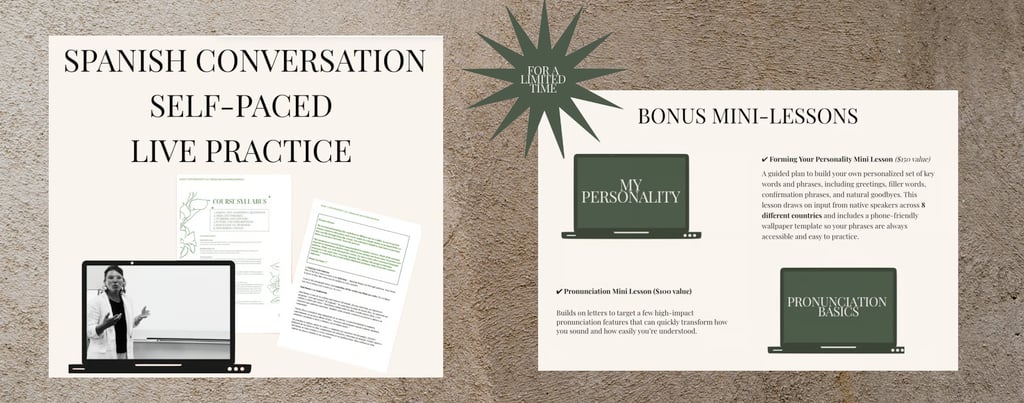
WE HAVE TWO SPANISH CAPSULE COURSES READY TO GO FOR YOU.
They are professor-led, self-paced, and communication focused. You could start today!

© 2025. All rights reserved.