
You Are Not the Problem: Why Spanish Felt Impossible and What Actually Works
If language apps and classroom Spanish left you freezing up in real conversations, the issue was never you. It was the method.
Hannah Pitner, PhD
4/2/20264 min read


Maybe you are here because you are ready to finally, really learn Spanish.
You have probably put in time. Language apps, vocabulary lists, maybe a class or two. You recognize words. You do well on the exercises. But when a real conversation happens in front of you, something goes wrong. Your mind goes blank. The words are not there. And you walk away feeling like the problem is you.
It is not.
If you learned English, which you did, your brain is fully capable of acquiring a second language. The problem is almost certainly not motivation or intelligence. It is method. And more specifically, it is that most language programs ask your brain to do something it was never designed to do.
Studying a Language Is Not the Same as Learning One
Most traditional language programs, and most apps, are built around studying: memorization, conjugation charts, vocabulary lists pulled from context, exercises that reward recognition. You get good at the format. You feel like you are making progress. And then you try to speak to a real person and realize the progress did not transfer.
This is not a personal failure. It is a predictable outcome.
Research in second language acquisition is clear on this point: we learn language the way we practice it. If you learn through games on your phone, you get good at games on your phone. If you learn through reading, you get better at reading. If you want language for real communication, you have to learn through real communication (Long, 1985).
What happens for adult learners in traditional programs is that they build a kind of false confidence. They can recognize vocabulary on a screen. But speaking requires something different entirely. When you are in a real conversation, you are managing linguistic anxiety, responding to unpredictable questions, and using a limited set of language creatively and quickly. Programs that ignore how memory, attention, and emotion work together almost always produce learners who stall, no matter how hard they are trying.
What the Research Actually Supports
The approach that research points to is called task-based language teaching, or TBLT.
Instead of organizing a course around grammar rules or vocabulary categories, TBLT organizes learning around meaningful, real-world tasks: things like coordinating a schedule, talking with a client, navigating a conversation about your job or your day. Grammar is not ignored, but it emerges through use and observation rather than memorization. You are not studying the language. You are participating in it (Ellis, 2003).
This distinction matters more than it might seem. When learners are focused on completing a real communicative task, they process language differently than when they are filling in a conjugation chart. The focus on meaning reduces the cognitive load that tends to cause adult learners to freeze. And because the language is connected to something real and relevant, it tends to stick.
Research has also expanded significantly since 2020 on how to create these kinds of communicative environments online, making task-based learning more accessible than it has ever been (Gonzalez-Lloret, 2020).
Why Adults Have It Harder and Also Easier
There is a version of the adult language learner story that goes: children are just better at this. And in some ways, the research supports that. Young children acquire language with less conscious effort, less anxiety, and no concern about making mistakes.
But adults also have real advantages. You already have a fully developed understanding of how language works. You have an enormous amount of world knowledge to attach new language to. You can read, infer, and make connections that a child cannot. The problem is not your adult brain. The problem is that most programs treat adult learners like they should be learning the way a child in school does, through repetition and rule memorization, rather than the way a child actually acquires language in the first place, through meaningful use in context.
When adult learners are given the right conditions, things shift. Anxiety decreases. Engagement increases. And learning accelerates in ways that feel, for a lot of people, genuinely surprising.
What This Looks Like in Practice
Linguaviva did not begin as a large program. It started with organizations asking for something specific: short, practical Spanish courses connected to the work their teams were actually doing. Construction companies. Nonprofits. Healthcare teams. Corporate environments. The learners did not need abstract grammar. They needed language they could use immediately, in the situations they were already in.
So the courses were built around real tasks. Interacting with clients. Coordinating logistics. Navigating the kinds of conversations that actually came up on the job. This task-based structure is not just philosophically appealing. It is what the research consistently recommends as the most effective approach for adult communicative language learning (Ellis, 2003; Long, 1985).
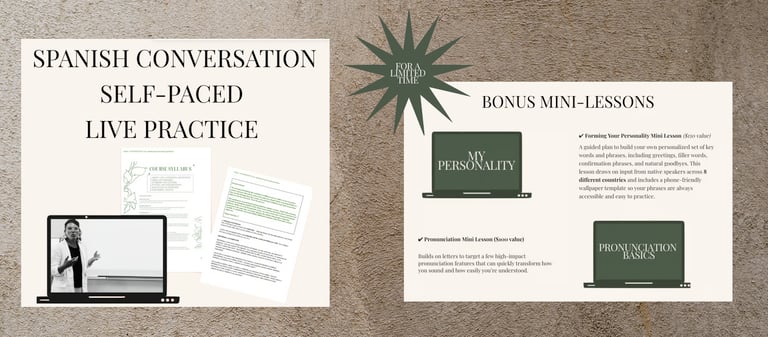
In practice, this means learners begin speaking from the first class. Rather than receiving conjugation charts, they work through inference-based activities that let their own brains construct the patterns. Grammar becomes something they notice and use rather than something they memorize and forget. And each module is integrated with a weekly conversation session with a native-speaking partner who is also learning English. The equal-power dynamic of that exchange matters. It reduces the anxiety that makes so many adult learners go silent, and it creates the kind of real communicative pressure that actually builds fluency.
One learner in a recent course had not studied Spanish since high school. She was 35. After five weeks, she held a thirty-minute conversation entirely in Spanish. She made mistakes. There were follow-up questions. But she communicated clearly, and she was understood. She was not exceptional. She was just working with a method that worked with her brain instead of against it.
The Broader Picture
For many adults, learning Spanish is not just about adding a skill. It is about feeling more at home where they live. Connecting more deeply when they travel. Communicating more effectively at work, or participating more fully in communities that matter to them.
That is a meaningful goal. And it deserves a meaningful method.
Your brain is already built for real-world language. It did this once before. What it needs is not more content to memorize. It needs the right conditions, the right tasks, and enough trust in the process to let it do what it already knows how to do.
Citations
Ellis, R. (2003). Task-based language learning and teaching. Oxford University Press.
Gonzalez-Lloret, M. (2020). Implementing task-based language teaching online. Language Teaching, 53(2), 1–12. https://doi.org/10.1017/S0261444820000689
Long, M. H. (1985). A role for instruction in second language acquisition: Task-based language teaching. In K. Hyltenstam & M. Pienemann (Eds.), Modelling and assessing second language acquisition (pp. 77–99). Multilingual Matters.

© 2025. All rights reserved.