What if your Enneagram type explains how you learn a language?
Early research suggests personality awareness may shape language acquisition in ways that matter. Here is what the studies found, and what they do not yet prove.
Hannah Pitner, PhD
4/2/20263 min read


Early research suggests personality awareness may shape language acquisition in ways that matter. Here is what the studies found, and what they do not yet prove.
Most conversations about language learning focus on method. Which app, which class, how many hours a week. But a smaller body of research has been asking a different question entirely: does who you are shape how you learn?
The Enneagram is a personality framework that describes nine core types, each defined by distinct motivations, habits, and responses to stress. It is not a new idea, but it has started showing up in applied linguistics research, and some of the findings are worth taking seriously, even if the evidence is still developing.
What the research looked at one study by Coker and Mihai (2017) worked with adult ESOL learners in an advanced English program in central Florida. Participants came from Haiti, Iran, Cuba, and Puerto Rico. Ten students completed the full study, which included an Enneagram assessment, open-ended questionnaires about their learning experiences, and a final reflection on how knowing their type might change their study habits.
Two researchers independently analyzed the data, then compared findings to identify consistent themes. It is a small study with real limitations, including the fact that the Enneagram test relies on language the participants were still learning. But the themes that emerged were specific and coherent enough to be worth examining.
When students understood their personality type, they began to understand why they learn the way they do.
What they found about each type
The researchers noted distinct patterns in how each Enneagram type engaged with language learning. These are not prescriptions, but observations from a particular group of learners:
1 The Perfectionist
Structured, detail-oriented, responsible. Strong study habits but can become frustrated when progress feels insufficient or expectations are not met.
2 The Helper
Motivated by connection and approval. Thrives in collaborative settings and learns through supporting and being supported by others.
3 The Achiever
Goal-oriented and self-assured. Excels with independent tasks and clear targets. Confidence grows when competence is recognized.
4 The Romantic
Creative and emotionally deep. May take longer to adjust to a new environment but brings original thinking and emotional investment to the work.
5 The Investigator
Analytical and independent. Prefers working alone and engaging with depth. Repetitive or rote tasks tend to disengage them quickly.
6 The Loyalist
Responsible and supportive, but prone to anxiety in unfamiliar situations. Benefits from predictability, reassurance, and a stable learning environment.
7 The Enthusiast
Energetic and easily bored. Learns best through variety and engaging activities. Loses momentum quickly with monotonous or overly structured tasks.
8 The Leader
Assertive, confident, and protective of their autonomy. Can be a strong presence in collaborative settings when given space to lead rather than follow.
9 The Peacemaker
Calm, adaptable, conflict-averse. Learns best in low-pressure environments. Can withdraw when overstimulated or when tension is present in the room.
What this does and does not mean
A separate systematic review by Hook et al. (2020) is honest about the Enneagram's limitations as a scientific tool. Its reliability and validity are still debated in the research literature. It should not be treated as a fixed or definitive map of who someone is.
A note on the evidence:
The studies in this area are small, qualitative, and exploratory. They suggest directions worth exploring, not conclusions to build policy on. Personality can also shift over time, and cultural and linguistic backgrounds shape how someone reads and responds to a personality instrument.
That said, the core finding from Coker and Mihai is consistent with what broader emotional intelligence research also shows: when learners have language for their own habits and reactions, they tend to engage with learning more intentionally (Thao et al., 2023). Self-awareness, however it is built, seems to matter.
Personality awareness will not replace well-designed instruction. But it can add something that most language programs underinvest in: a framework for understanding the human being doing the learning. Not just what method they are using, but what they need in order to feel capable, recognized, and ready to keep going.
Coker, C., & Mihai, F. (2017). Personality traits and second language acquisition: The influence of the Enneagram on adult ESOL students. TESOL Journal, 8, 432–449.
Hook, J., Hall, T., Davis, D., Van Tongeren, D., & Conner, M. (2020). The Enneagram: A systematic review of the literature and directions for future research. Journal of Clinical Psychology.
Sisti, F. (2020). Enneagramma, motivazione e stile cognitivo: Una prospettiva inclusiva per lo studio delle lingue straniere.
Thao, L., et al. (2023). Impacts of emotional intelligence on second language acquisition: English-major students' perspectives. SAGE Open, 13.
Huffman, L., Lefdahl-Davis, E. M., & Alayan, A. (2022). The Enneagram and the college student: Empirical insight, legitimacy, and practice. Christian Higher Education, 21(3), 214–232.
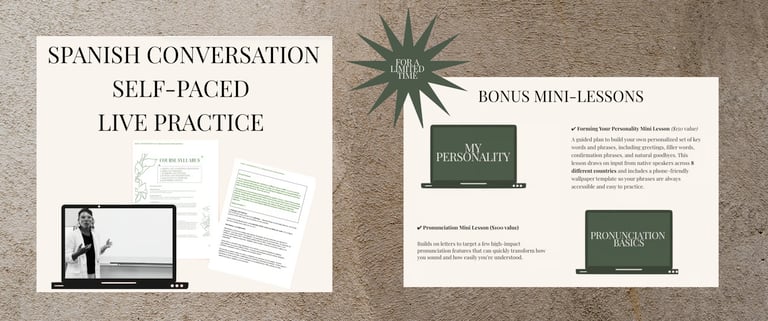
RIGHT NOW YOU CAN GET A FREE PERSONALITY MODULE WITH THE PURCHASE OF EITHER OF OUR SELF-PACED SPANISH COURSES.

© 2025. All rights reserved.