
"I just don't have the motivation." Research suggests that's the wrong diagnosis.
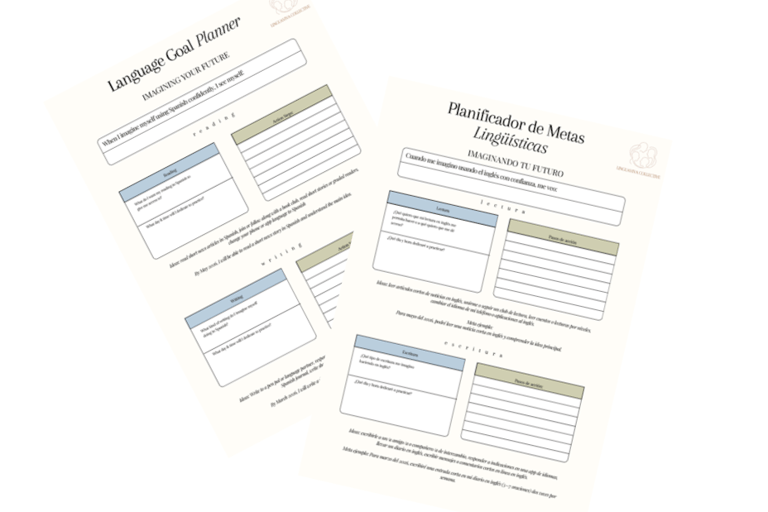
Bonny Norton's work on imagined communities reframes what's actually driving adult language learning, and what gets in the way + a freebie planner!
Lindy Avila
4/2/20262 min read


It's one of the most common things adults say about language learning. They started a course, tried an app, maybe took a class. And eventually they stopped. The explanation they give themselves: motivation.
But applied linguistics researcher Bonny Norton proposed a different framework entirely. Rather than asking how motivated a learner is, she asked a more useful question.
Who does the learner imagine themselves becoming through the language?
Imagined communities
Norton introduced the concept of imagined communities to describe the future social spaces learners picture themselves belonging to because of the language they're acquiring. These aren't abstract goals. They're specific, felt futures.
Imagined communities are the social worlds a learner envisions joining through language: not just speaking correctly, but feeling legitimate, confident, and included.
Those imagined futures might involve:
a new role at work
a different neighborhood
traveling independently
daily conversations
family relationships
professional credibility
What the research shows
Norton's research found that when the learning environment doesn't connect to those imagined futures, learners disengage. Not because of poor discipline or weak character. But because the instruction isn't supporting the identity they're working toward.
What gets labeled as a motivation problem is often, more precisely, a misalignment problem. The learner has a clear sense of where they want to go. The learning just isn't pointing in that direction.
More useful questions
If motivation isn't the real lever, the diagnostic questions shift. Instead of asking why someone can't stay consistent, the more productive questions are:
Where do I imagine using this language?
Who do I imagine speaking with?
What kind of language user do I want to become?
When learning is designed around those answers, persistence tends to follow on its own. Not as a result of effort or willpower, but because the learning is connected to something the learner actually recognizes as theirs.
Source: Norton, B. (2001). Non-participation, imagined communities, and the language classroom. In M. P. Breen (Ed.), Learner contributions to language learning (pp. 159–171). Longman. See also Norton, B. (2000). Identity and language learning. Longman.


© 2025. All rights reserved.